Relationship Training Program
For 6 weeks, we’ll be right by your side, step by step, helping you master the art of authentic attraction. You’ll never be alone on this journey together, we’ll transform every insecurity into natural charisma.

Your cart is currently empty. |
| Subtotal | 0,00 $ |
|---|---|
| Total | 0,00 $ |
Relationship Training Program
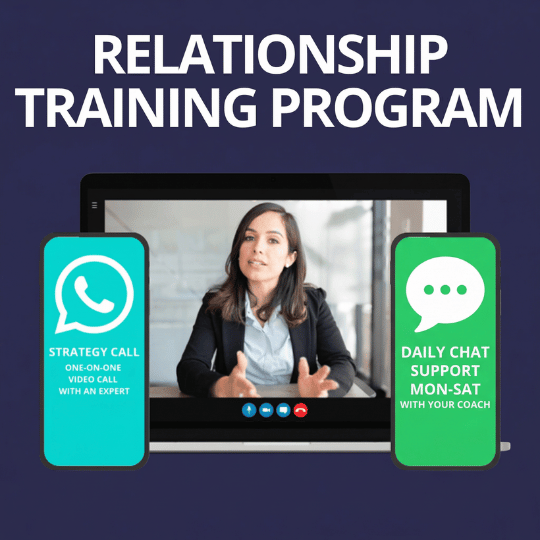
Here’s What You’re Getting:
- 6 Weeks of Chat Support: We never leave you hanging — you'll have your personal coach available Monday through Saturday via chat, ready to clear up any doubt and help you avoid making another mistake with her.
- Weekly Video Consultations with Your Coach: Every week, you'll have an in-depth video session with your coach to monitor your progress on the path to winning her back and plan your next moves together to get her back.
Got Questions?
We've Got Answers!
Our mission is to help men who have lost their ex win her back through strategic, psychologically calibrated, and field-tested messages.
What exactly is included in "Relationship Training Program"?
6 Weeks of Chat Support: We never leave you hanging — you’ll have your personal coach available Monday through Saturday via chat, ready to clear up any doubt and help you avoid making another mistake with her.
Weekly Video Consultations with Your Coach: Every week, you’ll have an in-depth video session with your coach to monitor your progress on the path to winning her back and plan your next moves together to get her back.
Who is this program for?
“Relationship Training Program” works in any breakup situation, including:
- She hasn’t replied in weeks
- You still live together but feel miles apart
- She’s already seeing someone else
- She told you “I’m done with you”
- You still talk but only as friends
- There was cheating involved
- You have children together
- She blocked you on WhatsApp, Facebook, or all communication channels
- You’re still together but going through a relationship crisis
- Long-distance relationships
Every situation is unique — that’s exactly why the program includes 6 private strategy call with our expert to tailor the method to your specific case.
Copyright 2026 © – All rights reserved
This website is not part of, and is not endorsed by, Meta Inc. (Facebook and Instagram) or Alphabet (Google).
Service Offered
The service offered is a project by Love-coach.online and refers to a specific video course on relationship coaching. Please note that:
The service does not constitute a therapeutic or psychological product or service. Individuals with medical conditions or disorders are encouraged to consult psychotherapists or other medical facilities.
The service is intended for cultural enrichment and entertainment purposes, as well as to discourage any form of verbal or physical violence, which must always be condemned and considered wrong, as any relationship must be founded on complete freedom and respect.
The service is a personal development tool designed to enhance one’s social and relational skills. The achievement of specific outcomes is not guaranteed, as results may vary based on numerous factors, including the user’s commitment to applying the concepts learned and external circumstances.
Artistic Representation
The character in the video is portrayed by a professional actor who faithfully represents the experiences and expertise of a real relationship coach on our team. The decision to use an actor was made to ensure clear and effective communication, while maintaining transparency and accuracy in the presentation of our services.
Scientific Studies
The advertised relationship coaching method aims to strengthen personal growth and individual development, focusing on aspects such as self-awareness, confidence, relational communication skills, empathy, and resilience, as well as improving couple or interpersonal dynamics. The main elements of the method are listed below along with their scientific sources:
Conceptualization: Aims to guide individuals toward a greater understanding of the importance of changing thoughts and behaviors to improve relationships, emphasizing mutual respect and building solid bonds. Key scientific references include: Behavioral theories by John B. Watson (1924). Research on cognitive-behavioral therapy by Aaron T. Beck (1979) and Judith S. Beck (1995). Reinforcement concepts by Burrhus Frederic Skinner (1938, 1953, 1971, 1957). “The ACT Matrix” by Kevin Polk, Benjamin Schoendorff, Mark Webster, and Fabian Olaz (2016). Studies on empathy and intersubjectivity by Vittorio Gallese (2003). Research on social and cultural cognition by Andrew Whiten (2018) and Richard W. Byrne (2018).
Zero Contact: This phase focuses on the importance of a period of detachment from one’s partner in certain circumstances, to encourage personal reflection and enhance one’s role in the relationship. Key scientific references include: The role of reinforcement and ignoring according to Burrhus Frederic Skinner (1938, 1953, 1971, 1957). The scarcity principle by Robert Cialdini (2001). Ethological theories by Konrad Lorenz. Studies on love and desire by Helen Fisher (2016).
Relationship Recovery: Based on the Gottman couple’s theory for improving romantic relationships, focusing on understanding, conflict management, and mutual respect. Key scientific references include: Principles for a successful marriage by John Gottman and Julie Schwartz Gottman (1999).
Evolutionary Levers: Focuses on how to influence instinctive mechanisms to create deep and lasting connections, aligning behavior with the partner’s needs and desires. Key scientific references include: Studies on the limbic system and triune brain by MacLean (1952, 1990). Reflections on the evolution of human intelligence by Carl Sagan (1977).
Preselection: Helps understand the concept of social attractiveness linked to preselection — how a person becomes more desirable when already chosen by others. Key scientific references include: The consensus and social proof principle by Robert Cialdini (2001). The concept of parental investment and sexual selection by Robert Trivers (1972).
Mindset: This phase is dedicated to developing leadership, self-control, and self-awareness through five key principles of self-understanding and self-esteem. Key scientific references include: Field force theory by Kurt Lewin (1951). Studies on attractiveness and social status by David M. Buss and David P. Schmitt (1993). Research on attractiveness and partner choices by Judith Dunn and Richard Searle (2010).
Care: Focuses on the importance of being perceived as a partner capable of taking care of the family — a crucial factor in a partner’s attractiveness and suitability. Key scientific references include: Studies on partner preferences for resources by David M. Buss (2012) and James W. Kalat (2013). Research on mating behavior by Nancy Macpeace Tunner (1981).
Vicious Cycles and Biases: Helps recognize and avoid vicious cycles and cognitive biases that can negatively affect communication and relationship satisfaction. Key scientific references include: “Thinking, Fast and Slow” by Kahneman (2011) and the article “Judgment under Uncertainty: Heuristics and Biases” by Tversky and Kahneman (1974). “Cognitive Therapy of Depression” by Beck (1979). “The Seven Principles for Making Marriage Work” by Gottman (1999).